
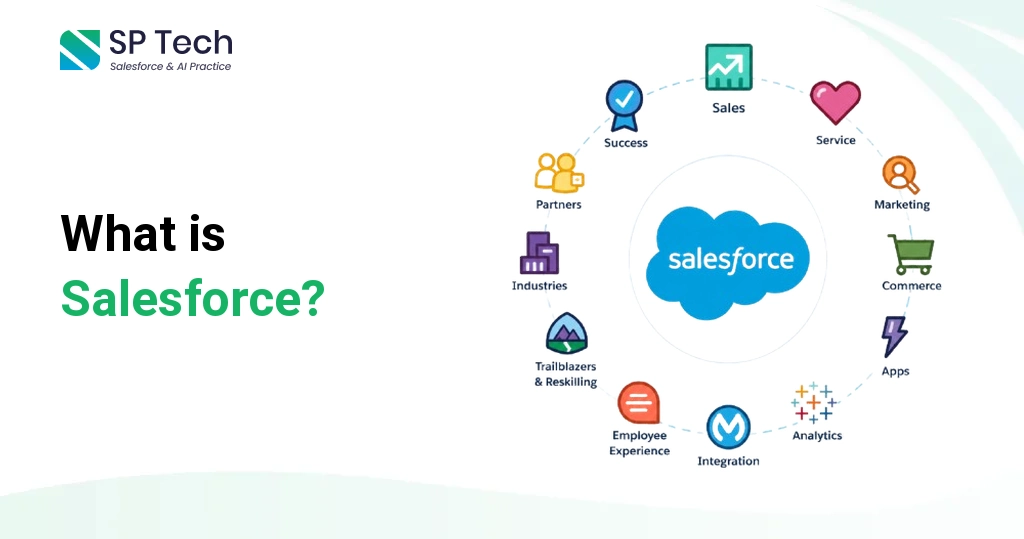

What is Salesforce?
Salesforce is a well-known cloud-based client Relationship Management (CRM) software that helps businesses manage client information, optimize processes, and spur expansion from a single, cohesive system. It helps companies provide more individualized and effective customer experiences at scale by bringing together teams from sales, service, marketing, and commerce. When people refer to SFDC meaning, they simply refer to Salesforce and its cloud application ecosystem.
This blog covers the main features, advantages, and technologies that make the Salesforce platform an essential tool for contemporary businesses.
What Does Salesforce Do?
To truly understand SFDC meaning, think of it as the operating system for your customer relationships. Rather than managing disparate technologies and dispersed data, Salesforce establishes a cohesive environment where all teams, from sales to support, rely on the same, up-to-date data. The result? quicker decision-making, improved client interactions, and more robust company outcomes. This is how Salesforce makes a difference:
- It creates a single, trustworthy picture of all consumer data.
- It frees up your staff by automating tedious tasks.
- It uses AI-driven insights to help make wiser decisions.
- It breaks down operational silos by tying departments together.
- It improves all consumer interactions, from initial contact to enduring loyalty.
Salesforce is more than simply customer management for leaders; it’s about building a more responsive, agile, and growth-oriented company.
Benefits of Salesforce
- Improved Cooperation: Teams from different departments may work together easily with shared data and connected tools.
- Enhanced Productivity: Automation reduces repetitive tasks, enabling teams to concentrate on strategic initiatives that encourage growth.
- Improved Customer Visibility: Salesforce provides a comprehensive view of customers, enabling tailored engagement, and better decision-making.
- Scalability for Growth: Salesforce grows with your business, hence making it perfect for businesses looking to expand over the long run.
Leading Salesforce Products Helping Companies Automate and Grow

One of the greatest advantages of Salesforce products is the ease with which they collaborate while meeting certain business objectives.
It is the core of the Salesforce platform that improves forecasting and efficiency by assisting teams in managing leads, opportunities, and pipelines.
It was created for customer service teams to facilitate quicker resolutions, more intelligent case management, and uniform service across channels.
An effective tool for developing tailored marketing campaigns that target consumers through the appropriate channels at the appropriate times.
Salesforce Financial Services Cloud
Designed for financial institutions, it improves relationship management, customer engagement, and compliance.
Provides a comprehensive perspective of patient data to assist healthcare companies in providing linked, patient-centered care.
Designed for digital commerce, it facilitates intricate B2B transactions and streamlines purchasing experiences.
Key Features of Salesforce
Automating Workflows: Enhances productivity by eliminating laborious tasks.
AI-Driven Insights: Leverage predictive analysis to make informed choices.
Customer Service and Support: Use AI-powered automation to provide omnichannel assistance.
Lead and Opportunity Management: Monitor and develop potential customers through sales pipeline.
Pipeline Forecasting: Determine any bottlenecks and forecast revenue growth.
What Salesforce Can Do for Your Business in 2026?

1. Boost Sales with Data-Driven, Smarter Decisions
Salesforce gives your sales teams automated workflows, predictive insights, and real-time pipeline visibility. Businesses can quickly discover high-value prospects and make accurate revenue forecasts.
2. Develop Robust Client Connections That Promote Long-Term Growth
3. Provide Seamless, 24/7 Assistance to Clients and Staff
With AI-driven service tools, businesses can improve response times and customer satisfaction by offering round-the-clock assistance through chatbots, self-help portals, and intelligent case routing.
4. Boost Sales with Frictionless Purchase Experiences
Salesforce Technologies That Drive Sales, Service & Business Growth
What is Integration in Salesforce?
Salesforce integration involves linking CRM with other business software. It permits smooth transfer of data between analytics, e-commerce, HR, marketing automation, and ERP systems with Salesforce.
What is the Impact of Salesforce on Businesses?
Salesforce is a strong driver of customer happiness, revenue growth, business flexibility, and operational efficiency. With capabilities like lead management, AI-powered forecasting, and Salesforce IT Services Management, organizations can improve sales productivity while maintaining reliable and scalable IT operations. Workflow automation eliminates tedious tasks, enabling teams to focus on high-value initiatives. Real-time insights empower businesses to make informed decisions that support strategic thinking and long-term growth. In a dynamic market, the adaptable, cloud-based architecture of Salesforce ensures organizations remain agile, resilient, and future-ready.
Conclusion
Salesforce is not just a CRM, it is a whole Salesforce platform that changes how companies run, interact with clients, and spur growth. From handling intricate sales pipelines to providing tailored client experiences, Salesforce offers the resources required to remain competitive in a data-driven world. Knowing what Salesforce does is essential for executives assessing digital transformation tactics. It fosters long-term success by bringing teams together, revealing ideas, and developing scalable procedures. Salesforce is a future-ready solution that is intended to produce quantifiable business effect, regardless of your objective, increasing revenue, increasing efficiency, or strengthening customer connections.


